Showing posts with label Beijing. Show all posts

Tuesday, July 6, 2010

A quick breakfast on my way out

My last morning I headed to the now-standard dumplings and noodles shop, hoping to grab a quick breakfast. I was surprised to see an entirely different cast of characters had taken over the shop for breakfast, making loads of delicious looking fried bread and steamed dumplings.


My dumplings were good. Light skins, not too heavy for the AM. The meat filling inside was flavorful but, again, not too dense. Excellent.

For other breakfasts in Beijing, I've has the pancakes stuffed with chives and garlic (excellent and garlicky), a fired bread not unlike the parantha of India (also yummy), and more steamed buns. And nothing ever cost more than 50 cents!

Also, though not for breakfast, I did get a chance to try ridiculously fresh yogurt.


All of the drinks shops throughout town had bunches of these clay jars on their tables. After tasting one, I knew why. Fresh yogurt, not overloaded with sugar, drunk through a straw. Delicious!

Numb, my mouth is so numb (and that's great!)

Final dinner in Beijing, and the challenge remains. Plan B has been put into operation, and all teams are a go. To dramatically increase the odds of a fantastic meal, I've resorted to drastic measures. I've recruited the cafe owner from the day prior to dine with me, showing me a great place for some local food. She graciously agreed and has picked a Sichuan place just down the road from her shop.


I had actually noticed this place the night prior! And skipped it! Why!

She raved about the Sichuan dry pot and so that is what we ate.


At its most simple, it is a large pot that you fill with the ingredients of your choice. They are cooked with plenty of Sichuan peppercorns and chillies according to your spice rating from 1 to 7. She leaned toward a 1, for my sake, and I convinced her we could go higher, settling on a 3.

It was so delicious! We got a cornucopia of ingredients, including preserved dried pork, beef balls, textured tofu skins, smoked tofu, young bamboo shoots, and long flat mushrooms. Each on their own was awesome. I particularly enjoyed the tofu skins, which had a crunchy texture and looked a bit like tank treads. The beef balls I had only had in soup before, and the dry version did not suffer at all, it was full of meaty flavor. The dried pork was the closest thing I've had to bacon in months, so good. We picked at the pot for the better part of an hour, and still had two large takeaway boxes of deliciousness to take with us.


It paired nicely with a unknown berry tea. The tea served as a much-appreciated heat reducer throughout the meal.

A hearty thanks to her for helping a traveller in need of a great last meal and completely coming through in the clutch. Her cafe just started, so should you be in Beijing, head over to Wudaoying Hutong near the Lama Temple and give her some business! Thanks, Yingying!

Cooking class, Day Five: Stir Fried Pork and Vegetables at Hutong Cuisine


Final day of cooking class! Our menu to take me home would be fish-fragrant pork, three treasures, and spicy dry-fried watermelon radish.

I'd been intrigued about the fish-fragrant pork ever since reading about it in Shark's Fin and Sichuan Pepper. There's actually no fish in the dish; rather, the spices are the same that are used in many fish dishes, hence the name. Pork was sliced into long thin shreds. A typical sauce of rice wine, light soy, sugar, cornstarch, and water was prepared. The new addition to this dish was pickled chillies, which were diced. These were fried in oil with the garlic and ginger, then the pork was added and quickly seared off. The sauce was added around the edge, and then the dish was done. The pickled chillies added a very nice flavor and some great color to the dish.


Three treasures is a neat name for a good dish. It contains eggplant, potato and green pepper, three treasures from the land. These are each sliced into thin wafers and then pan fried until golden brown. Then, the whole lot is mixed with a sauce concoction and left to braise. That's all there is to it! For some reason, though, this version did not taste nearly as good as the one I've had in restaurants. It was so different that I think it was a different preparation. I hope to learn the other one, which had much more color and flavor.


A final dish was the spicy stir-fried watermelon radish. The watermelon radish is an absolutely gorgeous vegetable, white and green on the outside and a rich light purple inside. Made into julienned strips, it is ready for the stir fry. In some oil Sichuan peppercorns and dried chillies are fried. The radish is added, quickly coated, and quickly cooked. Simple as that. This was delicious, still tasting like a garden with a solid kick.


Our group was neat, for the most part. A family of four from North Carolina was visiting their daughter studying here, and they seemed to be having a good time. A Danish guy was a good addition. Alas, as sometimes happens, there was one person who was off. Boorish, sexist, and could not stop talking, it was a relief for the class to end to get away from him. Subtle clues did not work and more severe measures could not be contemplated. Oh well.

So, five days of cooking planned, five days complete. In sum, I would give the "best cooking school of northern Beijing" to Black Sesame Kitchen. They each had their pluses and minuses. Black Sesame's food, in the end, just tasted better. With a more romantic point of view, my guess is it is because the two chefs in charge there seem to take more joy from cooking and to therefore put more love in the food.

The real benefit of these classes is to be seen. I am hopeful it carries over into a limited repertoire of dishes that I eat when I return to the States.

Going local, or at least trying to

There I was, finishing up my afternoon blogging session at a cafe, when I started chatting with the proprietor. Turns out she had a neat backstory, having just moved back to Beijing from the UK, quitting her job as an engineer, and opening up a cafe. Hopefully she'll have some luck - her espresso was great, cookies even better, and the soundtrack was right up my alley.

We also talked food, and she asked where I was headed for dinner. I pulled out Beijing Eats and read the name to her. It was a place called Long Yuan Tang, and it served food from Guangxi. She shook her head and said "that place will be so expensive, you can just tell by the name." Then, she told me a couple of stories of traveling in continental Europe and just following her nose, literally, to places off the street that looked good and were full of folks. She challenged me to do the same in Beijing. After some not-too-productive excuses, I realized she was right. In many ways, that is the essence of traveling and the spirit of this trip. With my guides and recommendations, I had started to wander a bit from the winds of chance.

So, shortly thereafter, I found myself cycling down the next street, following my nose and looking for some good supper. I did one loop just to take it in and know my options. Then, I zeroed in.

The place seemed perfect. It was full of people, with only one empty table (the one I aimed to claim). The ambiance was amazing. There was one guy with a really long goatee and a white Chinese suit that looked straight out of a kung fu movie. And there was a ridiculous TV show on, where a bear was riding a horse, I think. Plus, the food looked good and everybody was digging in. I got the menu, one sheet front and back of characters. Hmmm. I saw the noodles (mian - one food character I know) and the waitress was pushing me that way too. So I said yes, and she picked one. We also, I thought, had a hand signal conversation about getting some meat skewers from the charcoal grill going strong outside.


The bowl of handcut noodles arrived. It was very good, if straightforward. The noodles were lovely, irregularly cut in a way that means they must have been handmade. They were also chewy but not sticky. The broth was good too, a mix of chicken stock and black pepper. About halfway through, I added some chillies and that took it even higher, as there was a new roasted chilli flavor now.

The skewers never arrived.

In sum, an experience I've had before. I was looking for something better, something new, and something super tasty. I called an audible and planned a second dinner.


This was where I placed my bet. It similarly looked stuffed to the gills inside. Plus, I saw pictures of food, which meant I knew I could get something different. I made my move.


My first choice, however, was unavailable. It looked like an odd dish of squid arranged neatly on a platter surrounded by bok choy. So, instead, I went with the stir-fried and butterflied squid. It came with onions and peppers in a thickened soy sauce. It was, alas, mediocre. I could not finish it. The texture of the squid was interesting, as the scoring of each piece had done some real work. But the sauce and the flavor were off, with too much fishiness in the squid and way too much starch in the sauce.


The vegetable accompaniment was lotus root, fungus, lily pods, and snap peas. Somehow, this dish managed to underplay four delicious raw ingredients. The resulting hot stir fry was bland, with the flavors muted and under-seasoned.

Ugh. Not what I planned. Whatever bet I made, I lost. However, if there is one more thing I will do before I leave China, it will be to meet the challenge the cafe owner laid down. To Plan B...

Between two thoughtful temples, a throughful game

My cultural interlude on Monday took me to some religious cites northeast of my cooking school.

Stop one was the Yonghegong Lama Temple. Originally a prince's estate, it was converted into a temple that is still (highly) active today, with at least 70 lamas in residence. As it's active, it has been kept up fairly well, which means the architecture and the Buddhas inside were vibrant.


Near the front, there were two opposing dragon stela, that told the story of great deeds from ages past.


Also, in a large museum on either side of the main axis of temples was a museum of artifacts. I thought this conch shell scroll was quite neat, as were many one to two foot figurines of various gods and devils.


The main attraction came out of nowhere. In the back of the temple complex, I entered a three story building, expecting to see a golden Buddha about five feet high. Instead, I was presented with this:


More than 26 meters, or 80 feet, this large Buddha was carved from a single tree. The tree was sandalwood and was sent by those in northern India as a gift to the Chinese. It made my jaw hit the floor.

After the temple, I was bicycling to my next stop when I saw a couple of small crowds on the side walk. Pulling over, I saw that there were some competitive games of Chinese chess underway. I had to watch. I had just started to learn Chinese chess with Max after we picked up a traveling board. It is an intricate game with a handful of pieces that can do unexpected things (like the cannon that can jump over one piece to capture another). This game was transfixing. First, kibbitzing was clearly allowed, as everyone was talking all at once. One of the players, in particular, seemed to be spewing a relentless amount of trash talk. It was also a spirited match, with captures taking place with a loud bang of the table with the wooden disc pieces. Finally, I was amazed at how fast they played. When they set up, they would take about ten turns in succession, nearly instantaneously. As I'm still trying to learn how each piece moves, I could, alas, not follow. But, wow.

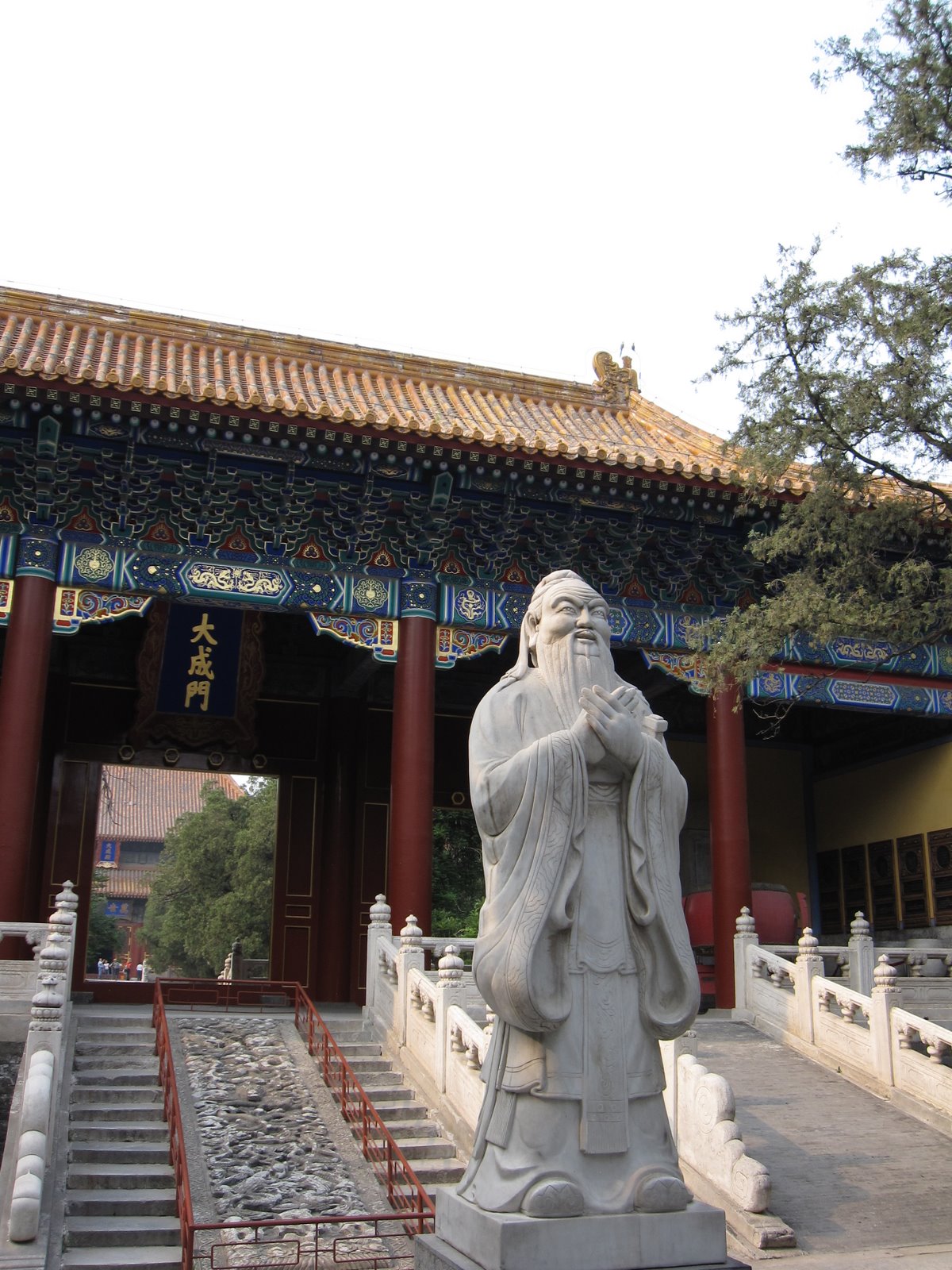
From there, it was down the street to the Confucian Temple. There was, as you might expect, a statue of Confucius.


There was also a hall of honor. There, I learned that Confucius had four sages and twelve philosophers (all essentially disciples that didn't quite reach his status). The hall was arranged to honor all of them, Confucius the most.


Other than that, this was a fairly nondescript place. Quiet, some trees, some nice buildings, but it wasn't long before I was back on my bike, getting lost in the hutongs.

Monday, July 5, 2010

Cooking class, Day Four: Chicken Stir Fries and Steamed Fish at Hutong Cuisine


The menu for the fourth day of cooking included gang bao chicken, Cantonese steamed fish, and ginger egg custard. It began in style, with each of us picking out dried chillies from the basket to prep for the gang bao.

Along with a dice of those chillies, we also portioned Sichuan peppercorns, diced ginger, garlic, and spring onion. Then there was the meat. Chicken breasts got a quick julienne, then were marinated in vinegar, soy sauce, cooking wine, and sugar, with a final coating of corn starch. Ingredients in place, time to head to the wok.


I have to say, I am still getting used to cooking with a wok and on high heat. Cooking times are measured in seconds, not minutes - it is so fast-paced! First some oil into the hot wok, a quick seasoning of the wok, then the peppercorns. When they brown ten seconds later, take them out but none of the oil. Then the chillies, garlic and ginger head in. Once that is aromatic, the chicken follows. This has to be moved constantly, but only in the middle of the wok, or else it will stick. Once it is seared on all sides, a quick add of the cornstarch, water, light soy, and wine mixture around the edge of the wok seals in the flavor to the meat. Add a dash of green onions and some peanuts. That's it, then you're done!


The steamed fish was a good change of pace from the stir-frying. We started with a whole little fish. Then, a couple of quick slices on the side to allow the meat to cook evenly. Top it with ginger, add some sugar and light soy, and let it marinate for 15 minutes. Then, into the steamer for about 10 minutes. When it comes out, top with sliced spring onions, then pour a small amount of hot oil on top, releasing the moisture of the onions in a loud hiss.


Lastly, there was an egg custard that was so easy and so good. Into a mixing bowl go milk and sugar. Then, beaten egg is slowly poured in as this is whisked. Finally, about half a root of ginger is juiced, with the liquid getting added to the mix. Place this in small bowls, top with saran wrap, and steam. This was delicious, with the ginger giving great aroma and subtle aftertaste to the custard.


It was a good day in the hutong kitchen. My cleaver and wok skills are slowly improving. Also, there were some neat other folks in the class, especially a couple from Australia who are on their own six month journey. The tales they had of the Trans-Siberian Railway! That may have to be a future stop...

A focus on the delicacy of sour

One of the cuisines on my hit list for this week of eating is that from the Guizhou province, in China's southwest. It is a hilly place, home to a large number of minority groups, most prominently the Miao people. The cuisine is demarcated by an intense fondness for sour. This is taken to such an extent that at the Flower Mountain Festival, a traditional song extols the virtues of sour. They also have a saying that translates as: "Go three days without a sour dish, and you'll stagger around and around." They are renowned for a sour fish hot pot and have an entire lexicon to describe different types of sour.

The place where I'll encounter this cuisine for the first time is Da Gui, recommended by Candice. It is a neat place, with an unmarked front door bedecked with red lanterns.


I make my way in. The place is surprisingly empty, though it is Sunday night. I grab a table and whip out Beijing Eats, making sure I go for the classics of this cuisine. The menu is a joy to read and I wish I was dining with eight. As I'm solo, however, I limit myself to three dishes.


The first is cow stomach dry pot. In a nicely sized wok, many, many pieces of cow stomach (or tripe) are stewing in a broth of celery, red chillies, green chillies, yellow chillies, and chilli oil. Did I mention there were some chillies? The tripe ranged from thin dark grey cuts to thick, whitish ones covered in half centimeter long stalagmites. I dug in with my chopsticks, fished out a piece of tripe or two, and swirled it in the chilli broth. It was delicious! Much of the fun of tripe comes in the texture, which is crunchy yet yielding. This hit that spot on, and added spicy flavor and spicy heat that built over time. I went back and back to this pot, fishing and fishing until there was nary a stomach lining remaining. I think I may be acquiring a taste for stomach...


The second dish was a classic, called liangban zhe'er gen, which translates as smelly fish grass salad. According to my book, the herb in this dish smells like smelly fish. It was described as a love it or hate it proposition. I landed firmly on the love it side (though perhaps a whole order for one person is overdoing it a bit). The leaves were great, like a sour, fishy spinach. The pieces that looked like bean sprouts proved resiliently hard and chewy, a bit like good-flavored branches. Definitely an array of flavors and a cumulative taste I had not experienced before.


The final dish was one of the very few desserts I have had in China, Da Gui specialty black sticky rice. The presentation was superb, with the cylinder of black sticky rice coming atop a silver platform, with crushed peanuts below. This was heavenly, a melt-in-your-mouth delight that made me pause with each bite. It tasted, incredibly, of rich chocolate even though there is not a drop of cocoa in the rice. Mixed with the peanuts, it attained a careful balance of sweetness and saltiness, softness and firmness. Excellent, delicious, wow.

So my first trip through Guizhou cuisine was a success. Not sure when the next chance will come - anybody heard of Guizhou food in the States?

Cooking class, Day Three: Dumplings and noodles at Hutong Cuisine

Midway into my week of cooking, I switch schools. Goodbye to the Black Sesame Kitchen (only home to classes on Thursdays and Saturdays); hello Hutong Cuisine! (I learned that Hias Gourmet is actually a middleman company, and the cooking school I'll attend goes by the much more sensible Hutong Cuisine.) However, as too much change can be painful, my first class at the new school will mirror the last class at the old one. That's right, dumplings boot camp continues!

But first, we go on a tour of the market. Well, the "market" - it's more of a low budget grocery store, with several vendors, one of each type, crowded into a medium size building. Initial impressions aside, the tour does get interesting as we see some of the ingredients I've been most fascinated with so far.


There is the tofu vendor. He has it all. Northern tofu (firm, called "bei dou fu") and Southern tofu (silken, called "nan dou fu") in bulk, various kinds of smoked tofu, tofu noodles, and more.


The dry goods shop has all sorts of wonderful things. There are red chillies, Sichuan peppercorns, dried wood ear fungus, all sorts of berries and nuts with purported medicinal value, and so many kinds of soy sauce and vinegar. The top-of-the-line Sichuan peppercorns here go for Y10 for 50g. I am wondering how far off the price will be when I get back to the States...


There is the noodle shop, with fresh noodles of every sort. I saw him cutting and flouring a new batch while we were walking around. Delicious!


And, of course, produce. Lots of tasty items, both familiar and strange. Gorgeous (though I'm betting bitter) bitter melon and some skinny green peppers that stand in for bell peppers with a little bit more pep particularly caught my eye. And so many greens!

From the market, it was back to the hutong courtyard, where the seasonings class took place. Very similar info to that provided in the intro at Black Sesame. The one piece of new info is that there are grades of both soy sauces and Chinese black vinegars, with higher numbers in the concentration of certain ingredients corresponding to more flavor (and higher price).

Then, it was dumpling time! Same basic three steps, though we started with making the filling. Our menu today had four filling types: pork and chives, pork and cabbage, beef and cilantro, and egg and chives (a nod to the vegetarian in our midst).


These weren't too complicated to make. Finely dice the vegetables. For those with high water content (I'm looking at you, cabbage), salt and let sit for 10 minutes, then squeeze out the water. Meanwhile, add light soy, cooking wine, ginger, and sesame oil to the meat, stirring it together all in one direction. Add water as necessary in small batches until you get a spongy coherent mess of meat. Then add the vegetables and stir in.

There was also a neat trick for peeling ginger. Using the back (blunt) end of the cleaver, scrape the ginger roughly and the skin comes right off, especially on fresh ginger. Quick and easy!

Next step, making the dough. With flour, add water in small batches, turning to create dough. Add water if too dry and flour if too sticky. Knead and knead and knead and end with a nice ball of dough. Cover to stop it from drying out. Then, roll it out into a long thin cylinder, about the diameter of a ping pong ball. Finally, cut off pieces, rotating dough by 90 degrees on the parallel axis each time.


Finally, add the filling to the dumplings and wrap. Flatten the dumplings with the middle palm of your hand, leaving the middle thicker than the edges of the small disc. Using a rolling stick, roll out the dumplings by rolling halfway, spinning the the dumpling skin 30 degrees with each roll. Two revolutions should be sufficient. Put the dumpling skin in your left hand, fill with moderate amount of filling goodness, then pinch one end closed. Now, on one side only, make a little fold, pinch together, and lightly attach to other side. Repeat all the way across to get a nice crescent shape in the dumpling.


With piles of prepared dumplings in hand, head to the kitchen. There, we learned how to pan-fry, steam, or boil the dumplings. Pan-fry method was the same as at Black Sesame, putting in a pan and crisping up the bottom, then adding water to half the dumplings' height and covering to let steam. Steam was straightforward, 8 minutes for veggie dumplings, 10 to 12 for meat dumplings. Boil was also easy, just make sure to turn down the heat when you boil them so they don't explode everywhere. The end result: many delicious dumplings to eat.


As side dishes, we saw the preparation of two vegetables. One was watermelon radish, which was julienned and then tossed in a sweet and sour sauce of sugar, salt, and vinegar. The Chinese cucumber was smashed repeatedly with the cleaver, coarsely chopped, and seasoned with a spicy and sour sauce comprised of chilli oil, sugar, salt, and vinegar, and a dash of sesame oil.


As an extra treat, Chunyi, our teacher, made handcut noodles. She rolled out a cylinder of dough until it resembled a large pancake. Then, with quick folds interspersed by flour, followed by vertical slices, long shreds of noodles emerged. After an instantaneous bath in hot water, these were ready to eat.


It was a good day of dumplings, deja vu. The extra practice made the techniques stickier in my mind (and my dough less so). It was fun to meet the Hutong Cooking crew - especially because Chunyi is teaching another staff member English, and so would repeatedly shout "English!" when the staffer would ask her a question or make a comment in Chinese. Repeatedly.