Showing posts with label Poland. Show all posts

Sunday, August 29, 2010

Penultimate food post: Memorable meals from the trip

122 days, 17 weeks, 4 months, a third of a year. Any way you slice it, that's a lot of eating. But what really stood out, what were the memorable meals? To answer that question, I'm going to use only my memory, and leave the blog archives for another time. After this chronological review, I'll sift it all down to a Top 8 of the trip. Here are the candidates:

Japan
Sushi near Tsukiji Fish Market: The freshest, fishiest, most flavorful sushi of my life (details)

Tasting menu at Chaya Mario: Unbelievably good tofu and surprise after surprise hidden away in Hiroshima (details)

Iron Chef Matsue nights: Round after round of local seafood and bizarre creations (details)

Indonesia
Roast pig at Babi Guling: Succulent, spicy, and celebratory, as all roast pigs should be (details)

Mangosteens on Gili Meno: The essence of simple, bursting with vibrancy (details)

Singapore
Intricate Chinese tasting menu: Taste after taste of new eats ending with a hands-on demonstration of a sensational omelette (details)

Long Beach seafood extravaganza: Fantastic black pepper crab and a steamed fish that was even better (details)

Ah boiling at a hawker centre institution: Amazing and amazingly unexpected peanut dumplings in broth (details)

China
Hunanese fish head: A very big fish head with very many chopped chillies, soon reduced to bones and nothing more (details)

Ha'erbin streetside dumplings: After many, many plates of dumplings, these reigned supreme (details)

Sichuan, Sichuan, Sichuan: A hotter-then-hot hot pot in Shanghai, a bowl of chili oil for poaching, and a dry pot so spicy it made me numb (details 1, details 2, and details 3)

Sour cuisine of Guizhou: A big bowl of pig stomach and sour seasonings and, as a side, smelly fish grass salad (details)

Turkey
Kofte with a view: Meatballs and uberfresh vegetables on one of the Princes' Islands in the Sea of Marmara (details)

Feast at Ak Deniz: Where the food started and just kept coming, showcasing Turkish food done right (details)

Turkish breakfasts: From Kale at the beginning to Caffe Privato near the Galata Tower, a range of treats that makes any morning lavish (details 1 and details 2)

Israel
Home-cooked food from Ima: Delightful starter spreads and a tour through the best of Israeli cuisine (details)

Poland
Zapiekanki to celebrate: A pizza baguette after a fantastic set of World Cup semifinals (details)

Germany
Eating without seeing: Going dark at a dunkelrestaurant with ok food but an amazing eating experience (details)

Biergarten all afternoon: The biggest and best pretzels I've ever seen, raw radishes with lots of spice, sausage and whole fish to boot, rounded out by stein after stein of delicious weissbier (details)

Brunch at Gugelhof: Seriously the best blood sausage and seriously surrounded by three exceptional brunch-time dishes (details)

Doner kebab at Hasir: After one bite, I could feel the new addiction forming (details)

Czech Republic
Redemption at Lokal: Czech cuisine saves itself with fresh horseradish, fresh dumplings, and great beer (details)

Denmark
Arty cafe treats: At the Louisiana, easily one of the best museums I've ever been to, the most beautiful food that was fresh and tasty as well (details)

The Netherlands
Late-night Netherlands: Stuff-it-yourself falafel and vlaamse frites with special sauces end any day well (details)

Monday, August 23, 2010

Do widzenia, Auf Wiedersehen, Farvel, Tot ziens, and Näkemiin, Europe: Some thoughts on my time in Central and Northern European cities

The month in Europe has had a different flow from that of the first three in Asia and the Middle East. Instead of two to three weeks in a place, it was more like four to seven days. So my reflections are a bit more numerous and pull from aspects seen in some, but not all, of the places I was in July.

The food can be quite tasty but it can also be wretched: My European destinations were, to put it nicely, not well known for being culinary destinations. But I had some great meals over the course of the month! For example, really tasty German food that was hearty and fresh at the same time (I'm looking at you, Gugelhof). And most of the meals didn't suck. But there were a couple that did (stop feeding me, you bad bad restaurant of U Babci Maliny!)

Lots of the good food has been imported: The flip side of shaky food cultures is that there's room for more. And, with centuries of exploration and contact beyond Central Europe under their respective belts, these places had managed to import some decent food. The Turkish food in Berlin, ah, I would love more doner kebab in my life. The Surinamese food in Amsterdam, a new treat that would get even better the more it was explored. And the list goes on.

World War II has left many scars and they're everywhere: Though I purposely went to Hiroshima at the beginning of my trip, I wasn't expecting World War II to be such a present theme. Yet it was. The unmistakable absence of Jews in Krakow. The horrible terror at Auschwitz. The memorials, some very recent, in Berlin, Prague, and Munich. Even in Amsterdam, where Anne Frank's house serves as a daily reminder to those bicycling the canals.

Cities so livable it hurts: In many ways it was a very urban month. Yet I didn't get any asphalt dreariness. A big part of that comes from the fact that these cities were just so nice to be in. Berlin and Amsterdam, in particular, bring well-rounded places just dying to be explored in depth. I won't soon forget the joys of bicycling Amsterdam. Or the ease of doing so in Copenhagen. These places have put effort into making the human scale the right scale for life in the city and it shows.

The roots of the English language become more clear: Knowing only a bit of Spanish in addition to English, I've been confused before as to the origin of much of English. Sure, some come from Romance languages, but others...? Now it is much more clear, having been exposed to German and Dutch especially. Even when it doesn't look like it, it sounds like, just with a very strange accent and some awfully unfamiliar words in between.

Sunday, August 8, 2010

Bevy of beards, part three

So much beard, so little time. Will my beard beat my blog back to the States?


Admiring the Wawel Castle in Krakow, July 9, 2010.


Supporting transparency in government at the Reichstag, July 16, 2010.

Sunday, July 25, 2010

A final plate of pierogies done well

I decided to keep it simple for my last meal in Krakow. I found a tiny little nameless diner on the corner of a street in Kazimierz.


I went in to order. I tried to get a plate of stuffed cabbage rolls. No dice. All it had, it turned out, was Russian pierogies, or the kind stuffed with potatoes and served with melted butter.


And it was pretty good! As I was eating it, I decided it tasted like oversized gnocchi in butter sauce with caramelized onions. Each pierogi was filled to the brim with fluffy mashed potatoes. Without the butter, it would have been a plate of potatoes, but with the butter, the bites were transformed into something very tasty indeed.

And with that bite, I wrapped up my time in Poland, satisfied with a good week and excited for adventures to come in Munich and beyond!

Public art and culture in Krakow

I have been delighted to see, in numerous forms, the vibrant arts in place in Krakow.


There were the vibrant sculptures filling up one of the squares of the Old City, bringing color and vibrancy to an otherwise very grey corner.

There was the live modern dance show I stumbled upon on the way home from the train station. A mix of romantic, social, and exuberant dance, all for free and all with the performers looking like they were having a fantastic time, jumping into fountains, rolling around in big bubbles, and playing with long pieces of cloth.


There is the upcoming Beatles Day on July 10th, just after I leave. In addition to a nighttime cover concert, there will be a variety of programs to explore the Beatles. Seriously.

There is the annual Jewish Festival that I just missed, which concluded with a big klezmer concert in the old Jewish quarter on July 4th. (more info here: http://www.jewishfestival.pl/index.php?lang=e).


And there is the Teatr Groteska, a puppet theatre. They apparently put on a fabulous (and wordless) show about the Golem, a legend made famous in Chabon's Kavalier and Clay. I would have loved to have seen that but it wasn't playing during my time here.

This place seems alive!

An unredeemably bad meal after some bad luck

For Friday's lunch, I was excited. I was headed to U Pani Stasi, a pierogi joint that came highly recommended from friends and from foodies online. I made my way there just after noon.

Oh no! Closed! For the whole month of July! Or, as the sign read, for 01 - 31 VII, which took me a little while to translate before my dismay could set in. I had no Plan B and really wanted good pierogies.

I gave Lonely Planet one more chance in the fine town of Krakow and headed for U Babci Maliny (or "At Granny Raspberry's", as it is translated). The place was full of kitsch but also full of people. I made my order at the front and sat down.


Dish one was oscypek z grilla z baczkiem, also known as grilled oscypek cheese with bacon. This was served on a skewer, with bacon alternating with cheese. It is one of the most inedible dishes I've come across in 3+ months of traveling. Wow, was this bad. The cheese was so hard to eat I had to stop myself from spitting it back out the moment I tried to take the first bite. It was so sharp and so old tasting. It was also indescribably chewy. And overcooked to the point of being burnt. And not good at all. The bacon, supposed to be the redeeming quality of the dish, was also so well done that it was largely carbon. I rejoiced when I found a little bit that actually tasted like pork. The only part of the dish I might have again was the cranberry sauce. Maybe.


Dish two was nalesniki z espinakiem z serem polane z czranydolo (or something vaguely similar...), or pancakes with spinach in garlic and cream sauce. Whoever made this has never heard of restraint. So much sauce and so much oil. Whenever I could find a little bit of the pancake that was bare, it was actually pretty tasty. Unfortunately that was only 5% of the dish, and the rest was a soggy, creamy, fatty, unappetizing mess.

So, Plan B failed. Big time. One more shot at a good meal in Poland, coming up tonight!

1,100,000 people, gone

Thursday was an intense day. When I arrived in Krakow, I learned that Auschwitz, the most infamous of all the concentration camps, was located not more than 60 km away.


I went not expecting to learn that much that was new. Having been to Holocaust museums in various places, including most recently in Jerusalem, I knew what occurred in those places. Rather, I think I went because I felt it important to go, to bear witness in some abstract retrospective sense.

The Auschwitz I camp, the smaller of the two, is where the majority of the museum exhibits are located. There, many, many artifacts of the many, many people that passed through are on display to give some bit of sense of the scale of the inhumanity that occurred. So many shoes, so many suitcases, so much hair.


But it was Auschwitz II, at Birkenau, that really made me pause. The place was so big, and so barren. The largely wooden barracks had all disappeared except for their brick chimneys (and the few that had been restored). The conditions so inhumane, with people piled on top of one another, given nowhere near enough food to live, and forced to do back-breaking physical labor that served no point. Beyond that were the crematoria, where the mass murder of people from all over Europe occurred. Of 1,300,000 people that entered the Auschwitz complex as prisoners, 1,100,000 were murdered. Jews, Poles, Gypsies, homosexuals, political prisoners, and others.

The memorial captured it right for me when it said, in 20+ languages:

For ever let this place be a cry of despair
And a warning to humanity
Where the Nazis murdered about one and a half million
Men, Women, and Children
Mainly Jews from various countries of Europe

Auschwitz-Birkenau 1940-1945

As I was walking out, I couldn't help but pause and peer down the railway track that led into this awful place of such inhuman acts.

Saturday, July 24, 2010

The other local specialities, those of Galicia

For lunch during my day of exploring Jewish life in Krakow, I went to the Galicja Restauracja. It's specialty was food from the Galicia region, especially wild game.


After ordering, I was treated to my first Polish amuse bouche! Some kind of very finely chopped meatloaf with a side of pickled cranberry sauce. The meatloaf was not so hot, a bit too reminiscent of what dog food may taste like. The cranberry sauce was delightful though.


For soup, I had the bulion z pierozkami, or broth with venison ravioli. This was excellent, especially the venison ravioli. They were meaty, and a different kind of meat, too, without being funky. A small but hearty soup that took me from deliriously hungry to ready to eat.


I'm glad I wasn't too full, either, because I had chosen a very large main. Placki ziemniaczane z gulaszem z dzika, or potato pancakes with wild boar stew. I should have known from the name this would be a massive dish! It was also quite tasty. The pancakes were well fried and held up even against the stew. Meanwhile, the boar chunks were nice and tender and, like the venison, different but not funky. I left a happy customer, quite full of game.

The remains of Jewish life in Krakow

As I was essentially living in the old Jewish quarter, I decided to dedicate a day to understanding the history of the Jews of Krakow, before WWII, during, and today. It was a fascinating and sad experience.


The first stop was the Galicja Muzeum, so named for the former Galicia which encompassed southern Poland and western Ukraine before WWI and is still considered a cohesive region. This was a great museum. The first exhibit focused on the life of Jews in Lvov, a Galician city that is now in the Ukraine. Some of the quotes of people about life before and during WWII were amazing.

Wiktor Chajes: "I dream about Palestine for Jews, I believe that is the only solution to the Jewish question, but personally the Polish sea is closer to me than Palestine is... by a strange accident of fate I am both a pole and a Jew... Jewishness is with me, but inside me is Poland."

And two quotes fascinating as a pair.

Lita N.: "I was brought up in a totally worry-free environment, enjoying the pleasures lovingly bestowed on an only child in an upper class Polish-Jewish home... We were Jewish, but ours was the classic assimilated life. My parents, unlike the majority of Polish Jews, did not speak a word of Yiddish."

Milo A.: "Yiddish was the language of adults, who used it when they were speaking about something that was not meant for children's ears. But when they would start to speak in Yiddish, I would try and listen twice as carefully."

The contrast with life in the ghetto was apparent.

Dov W.: "The level of dampness was terrifying. The walls were always wet, and in winter the water froze. I slept in a narrow bed, near the wall, and often I would wake up in the mornings and my pyjamas would be frozen to the wall."

Before the war, 150,000 Jews lived in Lvov, after, only 1,000.

A second exhibit examined the Krakow of today as a means for understanding the experience of Jewish life and the loss of Jewish culture. It had excellent photography, and really seemed to explore the contradictions, sadness, and hope of Jews in Krakow. It looked at old synagogues, old cemeteries, new festivals, and more in this vein.

From the museum to a quick tour of some of the remaining buildings and areas of the Jewish quarter.


The Remuh Synagogue, home to a storied Jewish rabbi and theologian, as well as the adjacent old Jewish cemetery in a fairly good state of repair.


The Old Synagogue, the center of upper-class Jewish religious life before WWII.


The new Jewish cemetery. In contrast to the old, this one had mixed upkeep. Some graves were as new as 2001 or so. Others were overrun with weeds and falling down.

From the quarter I went south, over the bridge and into Podgorze, where the Jewish ghetto was located during German occupation.


In the main square of the neighborhood, a well-crafted memorial placed 74 empty chairs in the place where the main deportations of Jews to concentration camps occurred.


Right there, on a corner of the square, was locally famous Pharmacy Under the Eagle, a pharmacy run by a non-Jew inside the ghetto that provided untold medications during the horrible years of occupation and served as a clearinghouse for information and as a hiding place for some Jews.


And down the street, one section of the former ghetto wall remains in place. In a sign of depravity, the wall was designed to look like Jewish gravestones at the top.


And, finally, to the enamelware factory that Oskar Schindler ran. The well-known subject of "Schindler's List" managed to save 1,100 Jewish lives. The building had been converted into a just-opened museum exploring what it was like during the German occupation of Krakow from 1939-1945. The museum was very similar to the National Museum of Singapore in that it used multimedia and tried to use every sense, especially sight, sound, and touch, to engage the audience. It was a time of immense brutality.

After the day's tour, I had a better sense of what life was like before WWII and during. I can still not fathom, however, how a city that used to have such a substantial Jewish population now has only about 200 Jews.

The Polish equivalent of the late night burrito

Tuesday and Wednesday, well, they weren't just any days. They are the semifinals of the World Cup! And, I have two of my favorite teams left in the mix. Holland, of course, which has been number 1 in my eyes since 2002. And Spain, a very fun team to watch that always falls in to very bad luck. So, I knew both of these evenings would be spent in some (hopefully atmospheric, hopefully lucky) bar watching these two matches. Tuesday played out precisely that way. The Netherlands-Uruguay match was fascinating, one of the best games I've seen. Both teams fought hard, and the Dutch made use of their opportunities to put home 3 goals. Wow!

To celebrate, I headed down the street to the main square in Kazimierz, Plac Nowy. There, a 16-sided building was full of purveyors of something called zapiekanki. After some sleuthing, this appeared to be a street pizza served and french bread. I was intrigued.


I headed for the place with the longest line. Curiously, some of them had no line at all but one had a line of about 25 people. Never one to go against the crowd when it comes to food, I hopped in line.


And the menu was fairly straightforward, thank god for pictures. When I got the front, I tried out my very beginning polish by saying the names of the ingredients I wanted. The cashier said "I'm impressed." That either meant "Nice job, I can tell you don't speak Polish, but you said that very well" or it meant "Listen, joker, why are you bothering me when I speak really good English." I couldn't tell. Regardless, I got my prize a little while later.


My zapiekanki came with salami (salami), szczypiorek (chives), kukurydza (corn), and ostry dracula sauce. It was excellent, the perfect "my team just won a World Cup semifinal" victory food. It was very large. It was very warm. And the ingredients all worked the way late night food should. Nothing was too in your face, rather it all easily blended together. The dracula sauce seemed to be some combination of garlic and hot sauce, and I would love to have a bottle of it. I don't think this was the healthiest meal of all time, but it sure was yummy.

An in-depth journey into pharmacy

One of Krakow's many museums had caught my eye, and became my afternoon. The Museum of Pharmacy in the Old Town was actually a branch of the Jagellonian University's School of Pharmacy and so was designed in a very academic way. It had an enormous repository of over 22,000 pharmaceutical relics from the 19th and early 20th centuries.


First I learned about the decoration of pharmacies. To quote Shakespeare:

"I do remember an apothecary,
And hereabouts he dwells, which late I note
In tatter'd eeds, with overwhelming brows,
Culling of simples; meagre were his looks,
Sharp misery had worn him to the bones:
And in his needy shop a tortoise hung,
An alligator stuff'd, and other skins
Of ill-shap'd fishes; and about his shelves
A beggarly account of empty boxes,
Green earthen pots, bladders, and musty seeds,
Remnants of packthread, and old cakes of roses
were thinly scatter'd, to make up a show.

Accordingly:


The basement also held some curiosities, both the poison section as well as the biggest bellows I've ever seen, which was over 2m in length.


There was also the gorgeous old apothecary setups, replete with a bottle for every possible tincture or solution. They had specially built cabinets and specially labeled jars just for this purpose.


Then, of course, were the normal and the bizarre stuffs they had that they used as medicine.


This table has a full jar of leeches (the translation of hirudines) out on the table.


Just your basic snakes, scorpions, and pickled lizards exhibit.


I'm not sure what to make of this, but it appears to be a unicorn horn.


Really, truly, that is mummy inside.


A jar of human fat (Axungia Hominis), just waiting for the right time.

Finally, I made it to the attic, where a whole set of medicinal herbs were hung to dry and others were captured in jars.


Truly, a fascinating and bizarre world to step into, if only for an afternoon.

Pierogies on Styrofoam

Lunch-time, time to start checking off some more of the Polish classics. This would be a pierogi-centered meal. I went to Bar Smaczny, in the Old Town. It is another cafeteria-style place.


I start with the salad sampler, which has dill and cucumber salad, broccoli in cream sauce, and sauerkraut with carrots. I am still surprised that the best was the broccoli, which I thought would be drenched in dairy and no good. I am also surprised that the cucumber salad was no good. But the broccoli was, it was excellent. The kraut was also more good than bad. I also had a apple and peach drink that was fairly good. If they would take some of the artificial junk out of it it would be even better.


For my main I went savory, with the pierogies with cabbage and mushroom. These were a sad let down. If this is Lonely Planet's favorite pierogi restaurant, then either this town can't make good pierogies or LP has bad taste. I wonder which one it is? These were mushy, overboiled. They were also bland inside, with the mushrooms having disappeared entirely. Bummer.

As a side note, I did not know you could get piergories with strawberries or blueberries inside. I will try to try those one of these days.

The search for good pierogies continues.

Wawel!

I declared Tuesday to be Castle Day. I would head north, to the Wawel complex on the hill, and focus my energies on the very large and nicely restored Wawel Castle. i would also poke my head in the cathedral right next door.


The castle itself was enormous, and had five separate areas that one could explore, each with a different, fairly costly ticket. I chose the State Rooms and the Armoury for my time there.

The State Rooms were exceptionally stately. Lots of marble, lots of very cool boxy and big wooden furniture. And lots of art. There were wall-sized tapestries depicting everything from Adam and Eve to the nine planets (assuming there were nine back then). One of my favorite rooms was the Throne Room, where an artist had placed 100+ carved heads into little one meter squares in the ceiling. Only about 35 were left, but they were very cool. Women, men, people of all classes, even a young man with curled horns.

The Armoury had its fair share of arms. I spotted swords, daggers, halberds, lances, javelins, pistols, guns, bayonets, cannons, and crossbows. And I probably missed something. Some of them had incredibly intricate detail or ornamentation. Some were also massively large, like the two-handed sword that was over six feet long. There was also the Szczerbiec sword, which was from the 13th century and has been used for coronations of successive Polish kings ever since.


The cathedral itself was filled to the brim. There were numerous small chapels, lots of celebrated graves, and a general attempt to beautify every surface in sight. There also seemed to be a lot of intrigue among historical Polish royal families.


In the courtyard of the castle was a life-size statue of Pope John Paul II, who hailed from a town not too far from Krakow. Apparently his town is known for its cream cakes...


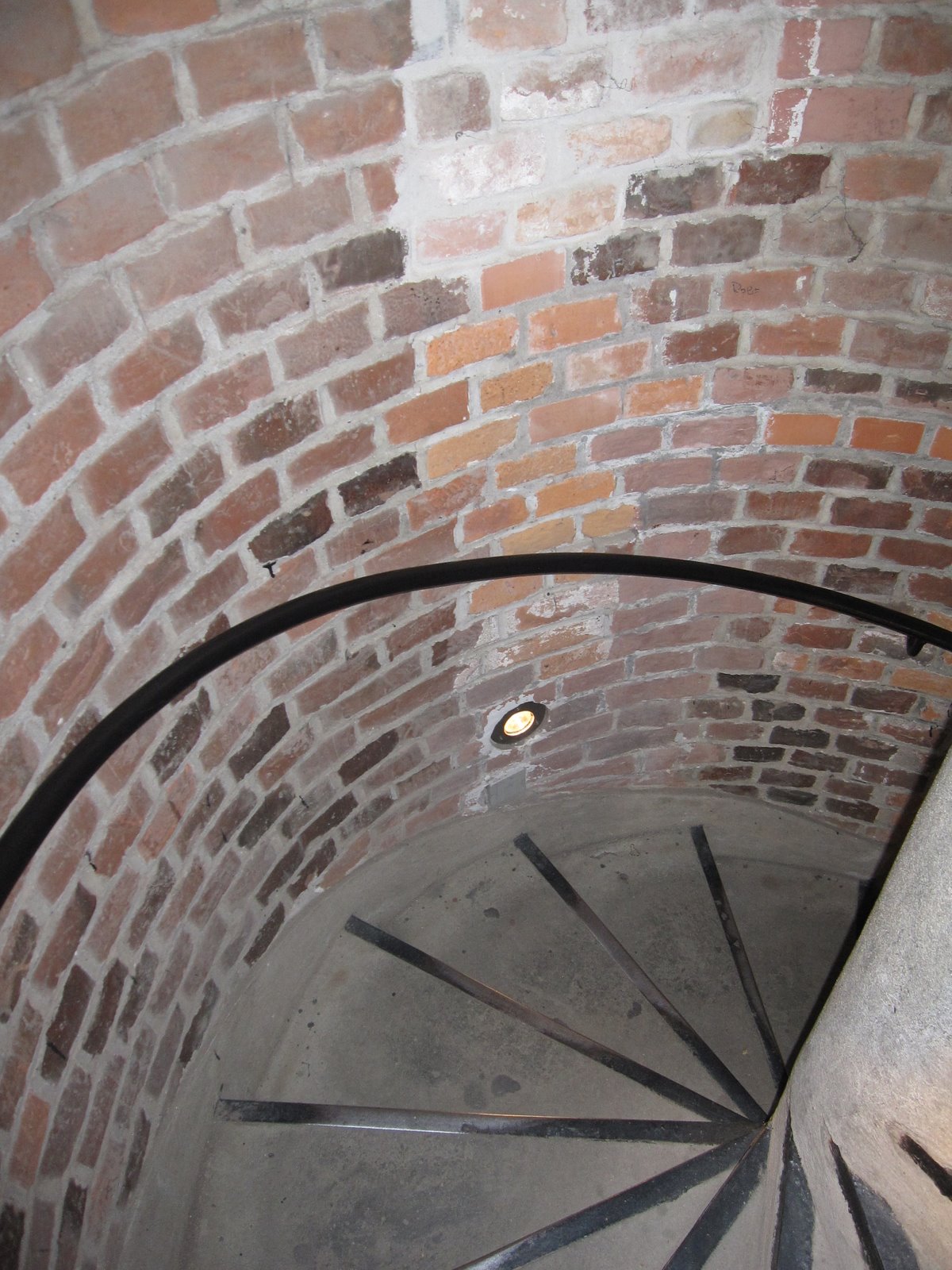
One possible exit from the castle and cathedral complex was through the Dragon's Den. I paid my 3 zlotys and descended a spiral staircase that seemed like it was going down five stories. I came out into a cave.


It was fairly well-lit, so I wasn't too worried. I kept walking through, avoiding the camera angles of those talking family photo shots in front of me, and soon emerged.


There, the dragon! Actually, it was a pretty cool dragon statue and a not bad view of the river that runs through this city. I ambled north into the Old Town in search of lunch.