Showing posts with label Japan. Show all posts

Monday, August 30, 2010

At long last, the Top 8 meals of the trip!

I figure I've had near 350 meals over the course of this trip. Many got highlighted on the blog. A full 28 got special recognition as memorable. But we have to get even more specific than that. We have to get down to a smaller list, and they will be ranked!


Last to make the list but not least in terms of yumminess, #8 is the fabulous meatballs on a hill in Turkey. Kofte at Yucetepe, a small cafeteria on the top of Buyukada, was spectacularly simple and delicious. The meatballs sang with the combination of freshly ground meat and a small number of spices. They were grilled to perfection, with char marks and a crisp exterior yielding to luscious medium rare meat inside. Superbly fresh veggies on the side, a hit-the-spot pilsner to wash it down, and a view of all of Istanbul's glory made the meal one of complete happiness. Full post here.


Lucky #7 is the brunch at Gugelhof. Were I ever to live in Berlin, I don't know how I'd let a month pass without making it here for brunch at least once. The flammenkuchen showed off the locally harvested chanterelles. The egg dish was simple done beautiful and perfectly. And the choucroute plate, oh choucroute plate, was bite after bite of delicious. The element that took this to the upper echelon, however, was the blood sausage. It was like cake, it was like sausage, it was like a pack of delicious spices. It was all of these things and more, combined to balance on the palate like an egg on a knife's blade. Full post here.


Just out of the top five but still on the list at #6 is the transcendent dumplings at the sidewalk stand in Ha'erbin. Max and I had variably luck, to be sure, but this meal made all missteps worth it. Perfectly cooked dumplings. The exterior, a rice-flavored pasta that had been hand-stretched and cooked until it was tender and chewy, but not sticky. The interior, a mix of pork and herbs that created a juicy flavor explosion with each bite. And the dumpling sauce, simple yet high-quality vinegar and chillies to bring the most out of each of the 16 perfect little pillows. Full post here.


Coming in at #5, the various Turkish breakfasts in Istanbul but, especially, the delightful treat at Kale. My first taste of simit, a sesame bagel stretched to the limit and toasted until crisp. My first plate of marinated olives that were so packed with flavor they didn't need stuffing. My first (and simplest) shepherd salad, with sliced tomatoes, cucumbers, and Turkish peppers mere hours from being picked. And the bal kaymak, well, about the bal kaymak I can only say that this clotted cream and honey spectacular may have taken some time off of my life but it was well, well worth it. Full post here.


Next up, at #4, the very unknown and very delicious tasting menu at Chaya Mario in Hiroshima. Presented by an ambiance that felt like a homey inn on the side of a travelers' road, I immediately warmed to the place and the two friends running the establishment. Their tasting menu, of which I only have the untranslated Japanese kanji, presented surprise after surprise with a handful of standouts. The first dish, a rectangle of tofu topped with salmon roe, redefined what tofu could be. A clam soup, thick with the grain of a barley, redefined hearty in the Japanese style. Importantly, early on, this meal blazed the trail of a true "What's That?" experience that would be an enduring source of exploration in the months to come. Full post here.


With the bronze medal, at #3, is fresh fish. But not just any fresh fish. The best fresh fish I've ever had. And I only had to wait three hours in the rain in Tokyo to have it, not a bad deal. Piece after piece of amazing nigiri sushi flowed our way. The uni was melting like butter from the sea, an extravagant bite. The spanish mackerel packed a wasabi punch that amplified the fish's own flavors. And the kawahagi, a slice of fish with a piece of its own liver on top, was the chef's recommendation and a truly unique mouthful. I was raving throughout and raving afterwards, and now I still don't know when I'll be able to have nigiri sushi again without comparing it to this fantastic set. Full post here.


Oh-so-close, our runner-up, at #2, the seafood feast at Long Beach Restaurant in Singapore. I knew I would love the pepper crab. And I did, oh I did. Savoring every bite, licking the black pepper flakes encrusted on the crab's shell, it was superb. But then! Out of nowhere! Golden river phoenix fish! Steamed a la Penang! Wow, this fish created new possibilities for what steamed fish could be. It was cooked so that a simple poke with a pair of chopsticks would reveal a luscious bite of fish. The fish itself, sans sauce, was full of great meaty flavor. But the sauce took it to the beyond and back. Tomatoes and scallions to bring flavor and depth and some chillies to add the needed kick. Long Beach is known as the splurge place in Singapore and I can definitely see why. Full post here.

And...

...the...

...winning...

...meal,...

...in...

...the...

...top...

...spot,...

...the...

...#1 eats...

...is...


...the amazing trio of Sichuan dishes I had over three weeks in China. The Sichuan hot pot, half and half yet full of flavor. When the big bold chillies overwhelmed, a brief retreat to the soothing broth would ready me for more. Sliced meats, great veggies, more pig brain, and Kung Fu noodles, definitely a full-on feast. The Sichuan dry pot, a mix and match of pick your own ingredients. The cow stomach, a new favorite for me in China, blended well with mushrooms, bamboo, and others. But, really, they were just a side note to the resplendent Sichuan peppercorn. This little feisty guy doesn't bring the heat, he just makes your mouth numb in an amazing, novel, and let-me-have-it-again way. And, at the top of the list of Sichuan meals, the near religious experience I had eating the slices of beef poached in chili oil. Sure, there were other things on my table, like lettuce and peanut sauce and some Chuan noodles, but the poached beef was king. Each bite transported me to a land I had not seen before, a land full of spice and heat. Each bite also confirmed that my chopsticks would head right back for the fiery broth just as soon as my corporeal body would allow. I walked home delirious from that night, that meal. These won't be the last great Sichuan meals I have. Full post here.

Sunday, August 29, 2010

Penultimate food post: Memorable meals from the trip

122 days, 17 weeks, 4 months, a third of a year. Any way you slice it, that's a lot of eating. But what really stood out, what were the memorable meals? To answer that question, I'm going to use only my memory, and leave the blog archives for another time. After this chronological review, I'll sift it all down to a Top 8 of the trip. Here are the candidates:

Japan
Sushi near Tsukiji Fish Market: The freshest, fishiest, most flavorful sushi of my life (details)

Tasting menu at Chaya Mario: Unbelievably good tofu and surprise after surprise hidden away in Hiroshima (details)

Iron Chef Matsue nights: Round after round of local seafood and bizarre creations (details)

Indonesia
Roast pig at Babi Guling: Succulent, spicy, and celebratory, as all roast pigs should be (details)

Mangosteens on Gili Meno: The essence of simple, bursting with vibrancy (details)

Singapore
Intricate Chinese tasting menu: Taste after taste of new eats ending with a hands-on demonstration of a sensational omelette (details)

Long Beach seafood extravaganza: Fantastic black pepper crab and a steamed fish that was even better (details)

Ah boiling at a hawker centre institution: Amazing and amazingly unexpected peanut dumplings in broth (details)

China
Hunanese fish head: A very big fish head with very many chopped chillies, soon reduced to bones and nothing more (details)

Ha'erbin streetside dumplings: After many, many plates of dumplings, these reigned supreme (details)

Sichuan, Sichuan, Sichuan: A hotter-then-hot hot pot in Shanghai, a bowl of chili oil for poaching, and a dry pot so spicy it made me numb (details 1, details 2, and details 3)

Sour cuisine of Guizhou: A big bowl of pig stomach and sour seasonings and, as a side, smelly fish grass salad (details)

Turkey
Kofte with a view: Meatballs and uberfresh vegetables on one of the Princes' Islands in the Sea of Marmara (details)

Feast at Ak Deniz: Where the food started and just kept coming, showcasing Turkish food done right (details)

Turkish breakfasts: From Kale at the beginning to Caffe Privato near the Galata Tower, a range of treats that makes any morning lavish (details 1 and details 2)

Israel
Home-cooked food from Ima: Delightful starter spreads and a tour through the best of Israeli cuisine (details)

Poland
Zapiekanki to celebrate: A pizza baguette after a fantastic set of World Cup semifinals (details)

Germany
Eating without seeing: Going dark at a dunkelrestaurant with ok food but an amazing eating experience (details)

Biergarten all afternoon: The biggest and best pretzels I've ever seen, raw radishes with lots of spice, sausage and whole fish to boot, rounded out by stein after stein of delicious weissbier (details)

Brunch at Gugelhof: Seriously the best blood sausage and seriously surrounded by three exceptional brunch-time dishes (details)

Doner kebab at Hasir: After one bite, I could feel the new addiction forming (details)

Czech Republic
Redemption at Lokal: Czech cuisine saves itself with fresh horseradish, fresh dumplings, and great beer (details)

Denmark
Arty cafe treats: At the Louisiana, easily one of the best museums I've ever been to, the most beautiful food that was fresh and tasty as well (details)

The Netherlands
Late-night Netherlands: Stuff-it-yourself falafel and vlaamse frites with special sauces end any day well (details)

Tuesday, April 20, 2010

Sayonara, Japan: some reflections on my time there

Though it was a last-minute addition to the itinerary, Japan turned out to be a splendid place for the start of this journey. Here are a couple of things I'll remember from the place:

The uniform and ubiquitous courtesy: Everywhere I went, I was always greeted with a smile. The shopkeeper's greeting - Irashimasse! - echoed from every store I saw. And, I truly mean every: I cannot think of a time when this did not happen. A couple of folks even went above and beyond this, helping a foreign stranger with no grasp of the language to find his way. There was the 7-11 cashier who, upon being asked where a local restaurant was, proceeded to escort me to the establishment more than two blocks away, asking for nothing more than a arigato-gozai-mas at the end. There was the baseball ticket taker at the Carp game who, when he saw my look of confusion as to where my seat was, proceeded to walk me up two ramps, halfway around the stadium, into my section, down to my row, and to point out my single seat. Wow.

The smart use of limited space: In such a small (physically) country, with a bunch of people, they have come up with some ingenious ways to use space well. There is of course the capsule hotel, which got its justice in a previous post. Even traditional Japanese architecture and culture seem designed to make fabulous use of the limited space. Japanese rooms with tatami mats are sparse, all doors are sliding doors, and no-one wears shoes. These all cause the space to expand. Perhaps most importantly, as explained by Yasuko, Japanese interior culture and design is defined by looking at a space while sitting on the floor. This brings all the furnishings into focus and really opens up the overhead space. Even better, some tables look like coffee tables, very low to the ground, but when you sit on the ground you discover a pit underneath the table where your (shoe-less) feet go. Ingenious!

The precision of the food: The dedication put into food design and eating in this culture! It was like a match made in heaven for me. I even coined my favorite word for describing it, sometimes meaning it seriously and sometimes when things were a bit over-done: precious. But it's true! When a department store food court creates so much food that look like works of art, well, it's precious. When to-go bought dishes come with ice packs, mini bottles of soy sauce, and the like, well, it's precious. And, when you behold some of the plating and originality of some of the dishes I and my friends sampled, well, that is certainly precious. I do not think I will have so many meals that were worth remembering in such a short time for a long time to come (and, yes, that is a challenge, future countries...).

1 country down, 7+ to go! Selamat datang, Indonesia!

Courting traveller's karma

Several times on this trip, I've had to put myself at the mercy of the travelling deities to come through. And, remarkably, they have - especially when I've given over control. Some stories!

There was the time in the Shibuya neighborhood of Tokyo, one of the busiest and craziest of many busy and crazy neighborhoods, when I needed a locker for my bags. I had just emerged from the train station, K had just left for the airport, and I was solo. I looked around and finally found some coin lockers but...full! I found some more, full also. I walked around and around this station (and it was a big station!) and kept finding more coin lockers and kept finding them full. I could feel myself getting tired and grumpy. Finally, after what seemed like an eternity but may have only been 30 minutes, I stopped. I simply stood outside of the ticket office, next to a bank of lockers, and waited. Lo and behold, within five minutes someone came, got their stuff, and FREED UP A LOCKER! The heavens rejoiced, or, at least, I did.

There was the time when I arrived in Matsue, looking for a place to stay. It was about 4pm. I walked for about 20 minutes to a accommodating looking place across from a temple. The door - locked. I could see no one inside. Hmmmmm. But I wanted a place to stay and it didn't look full. Again, I began to get tired from schlepping my stuff to and fro. All of the other places in my book didn't look close, nor did they look like what I wanted. Just as I was about to venture off, somewhere, anywhere, in search of a place to sleep, a minivan pulled up in front of me. She started talking in Japanese, but also used handsigns to ask if I was trying to get in. I said yes, but shrugged and tried to mimic that it was closed. No, she said, it's mine (pointing to her nose in a local custom that I hope to adopt). Yes! A PLACE TO STAY! And it was nice too, spartan Japanese room with comfortable tatami mat.

There have been countless others too. That Shingo was headed to Kyoto and offered us the chance to stay with him. That Yasuko let us stay on there. That the 7-11 cashier and the baseball station agent helped a poor guy who was oh-so-lost. Let me just hope that traveller's karma is the kind of thing that grows the more it is used!

Monday, April 19, 2010

Assorted food roundup - Japan

Some nibbles that didn't receive the full post treatment.


Meet yudofu. Yudofu is still boiling, fresh tofu. It (he? she?) was really quite tasty, milky and warm. Both K and I were spooning up the last scraps from this paper bowl.


An unlikely site at a train station, this Cafe Du Monde, with the slogan of coffee and beignets, had no beignets. No good. But the substitute pastries weren't all bad.


What's that, you ask? A skewer? Yes, but not just any skewer. A 2980 yen skewer of Kobe beef. Two pieces of meat, perfect for sharing. And worth every yen.


Quick, it's late at night in Okayama, you don't know the town, the hotel check-in person refuses to tell you of an open food establishment. Well, just head out to the rainy streets, wander into some random restaurant-looking place, and have some yakitori (chicken skewers)! These had all the main parts and also, I believe, chicken hearts (second from left).


A contender to vie against Mochi Cream? These stuffed waffles looked absolutely glorious in the display case. Fear not, Mochi Cream lovers, they were not up to snuff, your title still reigns.


Always a sucker for some more RF1, this bento lured me in from the moment I laid eyes on it. And it was delicious. The squid, yum! The eggy, roe-y noodles, yes! The unnamed vegetables in the upper left, why not! They should go into the travel food business and sell their stuff on airplanes in the states.

A gyoza-off in a rather odd setting

My final morning in Japan, this one in Tokyo. And what was left on my luist to do? One more food related adventure. This time, to Gyoza Stadium, in the Namjatown amusement area of the Sunshine City mall. Man, was this place intense!

When I arrived, 5 minutes before the opening of Namjatown, there was a crowd of folks all queued up, just anxious to get inside. There were two types: families with elementary school age kids and early teen / tween packs of girls. Oh, and me.


Inside, there was Gyoza Stadium, of course. There was also a very tacky spa, some small amusment rides, a ghost hunter game that was very popular (and had packs of people running around with Ghostbuster-like wands, looking for hidden ghosts), a dessert festival and udon village. And I'm sure there were parts of this place that I couldn't even understand.

The Gyoza Stadium part was decked out in 1950s Tokyo. Each place had many color pictures of the many types of gyoza on offer. As with the Ramen Museum, they were famous places from around Japan.


I tried three different gyoza, using up all my spare yen.


These were gyoza with miso butter sauce. The sauce was tasty. The gyoza, were, alas, not crispy enough and so came across as soggy and overcooked.


These were super-crispy bare gyoza. They had great crunch and the shell was terrific. The filling was ok, nothing much to mention there. This place also benefited from the ambiance of a picture of their chef with a lion in the background.


Finally, there were these eight cylindrical gyoza. Covered in a soy sauce with scallions, they were great little bits.

I was bummed that I didn't have more time, more money, and more kanji reading ability because there were 11 shops each selling about 20 different types of gyoza!

My night in a capsule

2 meters by one meter by one meter. Or, if you're counting, 2 cubic meters. That's how big my bedroom was last night. And it wasn't so bad!


The capsule hotel exists in Tokyo for two reasons: (1) it's a very expensive city and accommodation can be crushing to the wallet and (2) the superb public transit system stops abruptly at 12 midnight, so it's fairly easy to get stranded in the city. Turns out while they are less expensive, they're not exactly cheap: mine was 3700 yen, or about $40.

It works a little bit like this. You go in, take your shoes off, put them in a little locker. You then give that key and your yen to the desk clerk, who gives you a wristband with a key and a number on it. The key is for your locker in the locker room.


The smallness of the place extends to the locker room too. There's basically room for a suit and a briefcase in these irregularly shaped lockers. You change into your pjs, helped by the provided yukata (cotton robe). Then, you venture upstairs to your assigned floor (mine was 9) and see a row and stacks of capsules. Mine were 2 high and about 5 across. The front is open, with a little wood curtain you can pull down. Inside there is a tv, light, radio, alarm clock, and air conditioning. That's it!


When fully ensconced in my capsule, I had about one inch of space beyond my head to the wall and another inch from my feet to the wood curtain.

It turned out to be totally straightforward, a lot less sketchy than I imagined, and a decent night of sleep. And now I can say that I've slept in a box!

Bicycling through rice paddies

Egged on by my experience on bike in Matsue, I made a quick stop in Okayama to head to its outskirts for a daylong ride through the Kibi Plain. The basic gist is that you go to one train station on the outskirts, rent the bike, pick up the bike path ("cyclists only" at certain points, thankfully), and cruise for 15km through the countryside, seeing temples, towns, and farms. Pretty sweet, right?

The whole area is associated with this cool legend of a peach-faced boy, Momotaro, who killed the evil creature that was plaguing the town in an epic battle on an island. In tribute, they have put his face everywhere, including on the manhole covers.


I was starting with one leg tied behind my back, or, rather, both knees scrunched up into my face: my bike was too small! Assured several times by the rent-a-cycle proprietor that it was the biggest she had, I made do. Here's the puny thing:


I was longing for the bike I left in Matsue...

However, there were some cool temples...


...parks...


...gardens everywhere growing delicious produce (gardens aren't just for rocks, it seems)...


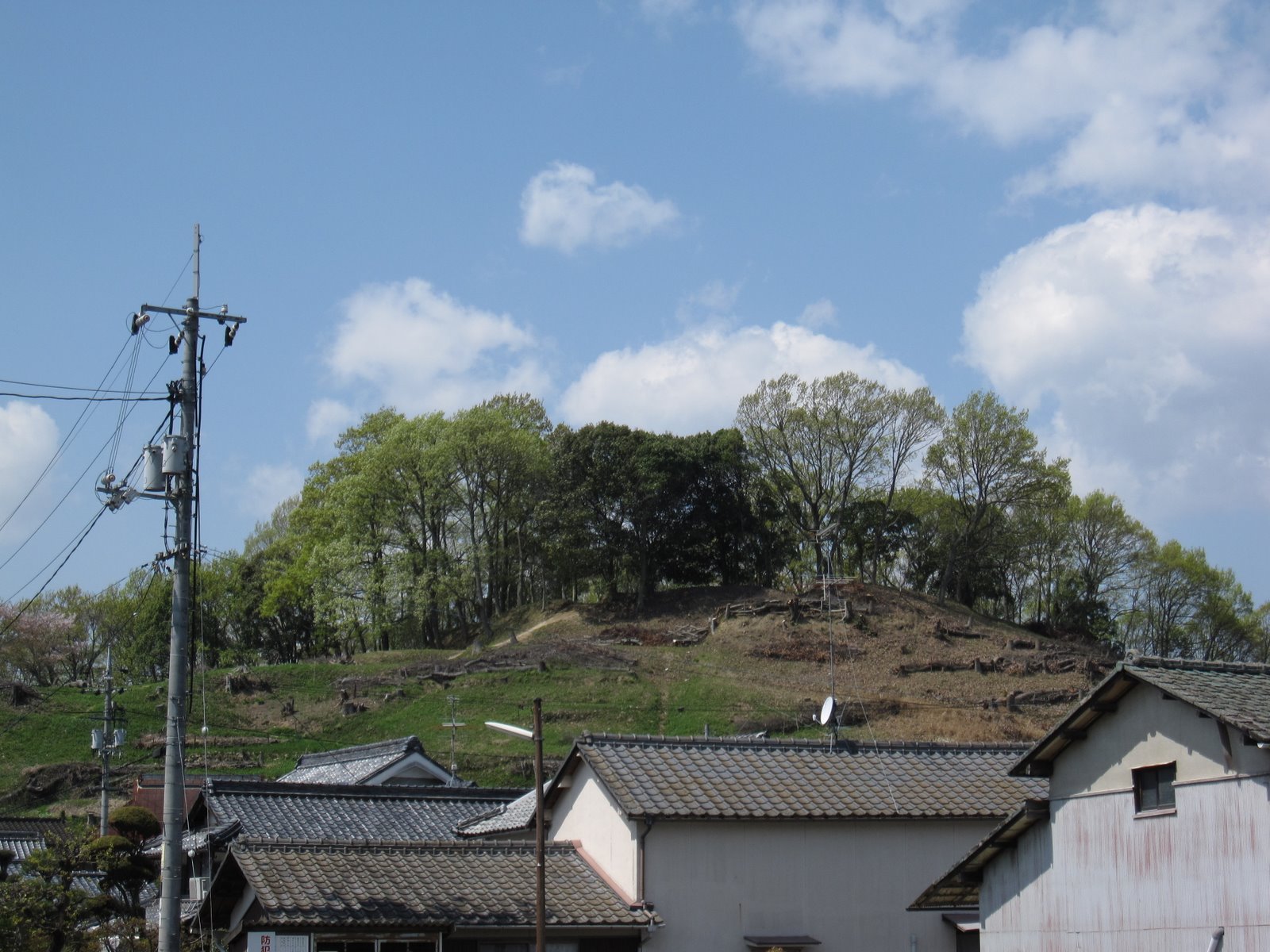
...and even a 350m long burial mound!


Even though the signs were excellent, superb, really...


...my favorite part was when I lost the train, followed an unlikely path into the woods, and was rewarded with a bamboo forest, purple wildflowers, a cave, and some little creatures.


And I eventually rejoined the trail too, which was nice! The crowning glory of the ride was a majestic five story pagoda, especially as it was just sitting there in the middle of the plains.


And with that, me and my miniature bicycle pedaled our way to Soja and to the return train to Tokyo.

Big shrines bring big luck

While in Matsue, I decided to pop over to Izumo Taisha to see their Shinto shrine, the second largest in all of Japan. The shrine had the usual large gate out front.


It also had a pretty cool sculpture of a guy (not sure if he's a monk), challenging an oncoming wave that has a large sphere perched perilously on top of it.


The highlight of this particular shrine are the enormous braids that welcome visitors into the main hall area. These braids are said to give good luck to anyone that can lodge a coin within them. I found myself lucky on the third try! (And if you think that's cheating, well, most people were trying at least five times before giving up...) I wait to see how my luck plays out.


At these shrines, there are also opportunities to pay a nominal fee to purchase specific prayers and protections from the deities. These weren't translated here, but elsewhere the two most popular appeared to be "happy marriage" and "safe driving". In addition, there were some neat prayer trees where visitors had tied prayers.


Unfortunately, my timing wasn't superb. Turns out the main, large shrine hall is undergoing a complete renovation and so was completely covered in warehouse scaffolding. I guess that's what my book meant when it said repairs are underway from 2008 to 2013!


Also, at the scale model museum, I saw a scale of a really neat looking staircase leading up to a shrine on stilts. In a painting of this, it was on some watery coast as well. Couldn't locate it in the real world, so I (and you) will have to content ourselves with this photo.

Sunday, April 18, 2010

A great little dip

The onsen - definitely one of those how-did-I-not-know-about-this-sooner things in Japan. Literally, it means hot springs, and they are a dime a dozen in these parts. According to my book there are urban onsen, oceanside onsen, riverside onsen, onsen towns, clifftop onsen, hidden onsen, semitropical onsen, onsen with beach, onsen with sand bath, mountain onsen, do-it-yourself onsen, and onsen ski towns. Whew!

For my part, I was only able to bathe in two of these marvels. The first was an urban onsen in Kyoto - essentially a public bathhouse. It was segregated by gender, where you strip down completely, then wash up (onsen are for soaking, not cleaning), and then soak away. The Kyoto bath had many different kinds of pools. Inside, there was a cedar tub, electric tub, mud tub, hot hot tub. Outside, there was a cool tub and a warm tub. Each are fed with natural hot springs.

The second was at a small onsen town outside of Matsue, called Tamatsukuri Onsen. I got off at the little railway hub for this town, then walked for 15 minutes along the river. The walk itself got me in the mood, as their were sakura hanging down everywhere.


Then I got to my onsen. This one was basically in a spa hotel, which is how these onsen were setup (the accommodations were very posh and very Japanese). I paid my day fee of 800 yen and then went into the changing room. Emerging into the onsen, I found two large pools, one indoor and quite hot, the other outdoor and rock-lined, surrounded by a quiet little garden. What a setting! The next hour was pure delight.

These onsen almost merit their own trip to Japan, to explore all the different types on offer.