Showing posts with label Jerusalem. Show all posts

Sunday, July 11, 2010

Bevy of beards, part one

There's been no shortage of beard recently.


The beard admiring the excellent view from the Istanbul Modern, June 11, 2010.


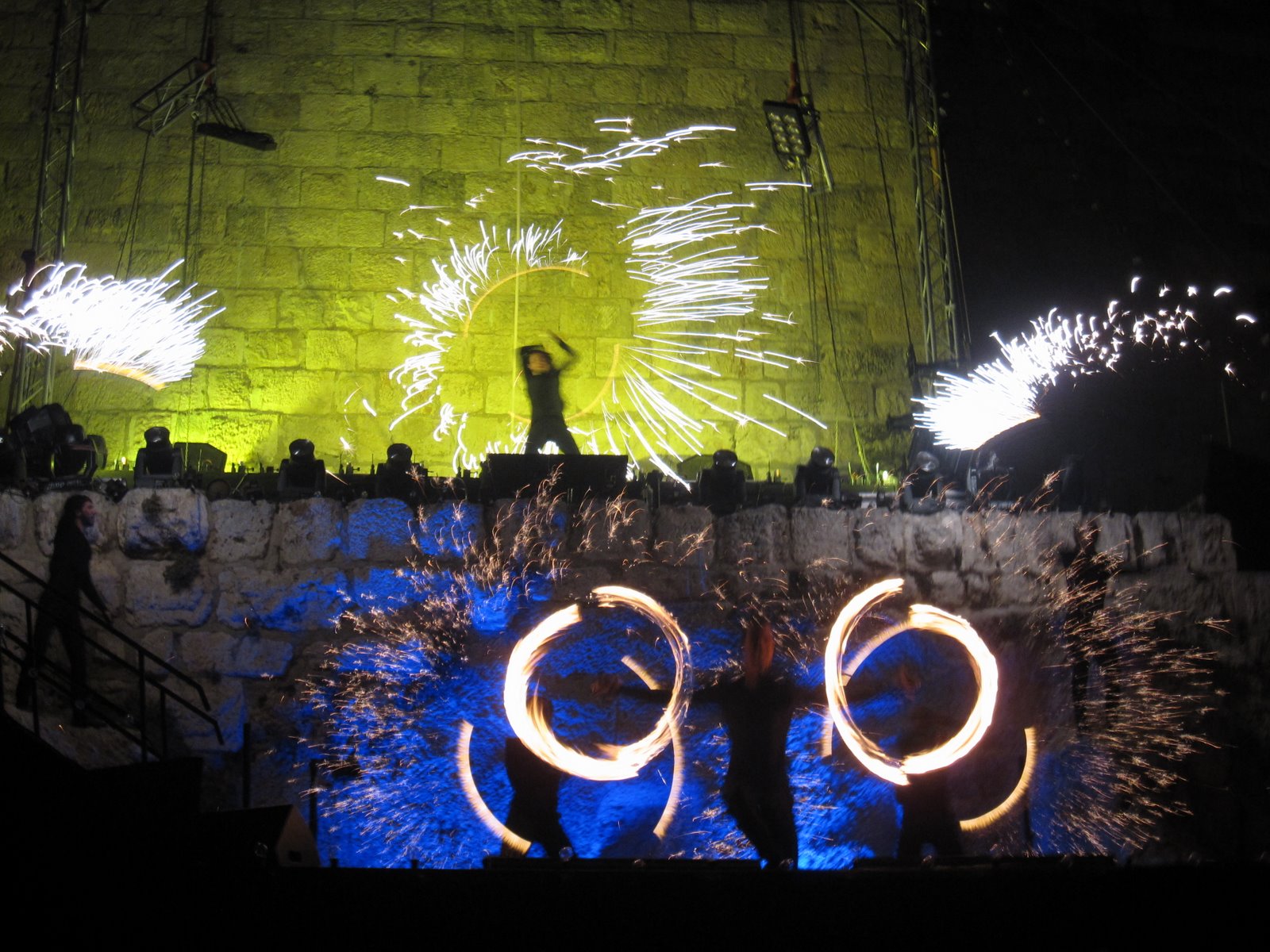
The beard glowing in the lights of the festival in Jerusalem, June 16, 2010.


The beard taking in the Dead Sea and its tributaries, June 18, 2010.

Superb food in a sizable cave-like setting

On our way home from the market, we had a determined destination for dinner: the highly-recommended Ima Restaurant, a family-run place whose name means "mom." The place was neat, with thick, rough rock walls and many small rooms lending a cool and homey air to the meal.


The first plate to arrive at the table was fresh pita, olives, and spicy tomato salsa. All were delectable. The pita was fresh and fluffy, still warm from the oven. The tomato salsa was an excellent take on a chunky, spicy gazpacho, with a bit of extra oil added. A terrific start.


Next was a set of three meze, clockwise from top left: matbucha, eggplant salad, and tabouleh. All were great, and each of us liked a different one best. The matbucha was a spicy tomato salad that had a good Middle Eastern spice to it. The eggplant salad was smooth and full of delicious eggplant taste without the bitterness. And the tabouleh blessedly had some olive oil added and was not dry at all, soaking into the pita with relish.


Then, a stuffed vegetable course, in this case a stuffed pepper. A fine rendition of a somewhat boring standard. Would be better to reinvent this one somewhat, adding some spice or some heat.


The kitchen quickly got back on track with the kubeh mustanfa soup. The kubeh, or meat dumplings, were chewy and flavorful, soaking up the tomato-based broth when opened. The squash that came roughly chopped was also hearty and excellent. Looks like red soup with beige filling, but tastes delicious!


And, lastly, there was the nightly special main, lamb meatballs wrapped in grape leaves with tahini sauce. Oh. My. God. These were transcendent. The lamb was perfect, spiced and seasoned and still quite juicy. The grape leaves were soft, able to be cut easily with a knife and providing a refreshing backdrop of greenery. And the tahini was diluted to the right consistency, not too viscous. So excellent, and so new. Delightful.

Of special note was the excellent Israeli wine we had there. It was a Syrah / Cabernet blend, from the Golan Heights region, and it was very nice. Not too thin and not too acidic, it helped the lamb be all it could be.

Also of special note was our waiter, Sonia. Out of many gruff servicepeople we've come across so far, she was friendly, laughing a couple of times, and helpful, telling us which dishes were note the best.

Ima may have just captured "best in Israel" from its Cafe Paradiso competitor.

A market and a nosh

The final destination for our time in Jerusalem was Machaneh Yehuda, a pedestrian produce and foodstuffs market known throughout the town. This was a neat market, with Israelis of all stripes doing their shopping in advance of the Sabbath and the weekend.

Based off the central artery of Agrippas St, several lanes were stuffed with fruit stands, vegetable stands, candy stands (the gummy selection is immense and everywhere in this town), meat stands, dessert stands (baklava...), spice stands, and more. It was all so colorful, so beautiful, that I could have just walked around for hours. Here is a selection of shots from the stroll.


Along the way, we stopped at an interior, bustling cafe for a quick bite to eat. It was highly European and I was delighted to order a Hoegaarden when I saw it on the menu.


To pair with that, I got a Camembert and warm mushroom sandwich on rye. Delicious, with warm, melty, gooey cheese mixing with the flavor-bursting mushrooms. Yum. It's not much to behold visually, but it worked to eat.

A sobering experience, as it always is


Day three brought a chance to understand more deeply the rationale for the founding of Israel. We headed to Yad Vashem, Israel's Holocaust Memorial and Museum. It was a profoundly powerful experience.

The museum itself is an imposing bare concrete structure. The audio guide contains interesting detail and stories that bring some of the different eras to life. Proceeding chronologically, the museum never rushes the storytelling. This resulted in me learning much more about the years in the late 30s in Europe than I had before.

One detail I had not heard much about before was the world's relative unwillingness to accept Jewish refugees needing political asylum. Indeed, the Evian Conference of the late 30s left nearly all the world powers, including the US, adopting stringent and quite selfish positions of stagnant quotas when Jews needed to flee Germany and other countries under Hitler's grasp. I would hope we are all collectively a bit wiser about the need for asylum in similar situations today.

The power in the experience came both from the detail in the stories and in the extent of suffering. Small specifics, like a anti-Semitic board game that children used to play, brought home the gestalt of the time. The procession of exhibits, including the build up to the war, the war, the ghetto-ization of Jews, and the mass murder of Jews and others, left a cumulative effect on me.

There was one uplifting part, near the end of the museum, where non-Jews who risked their lives to save Jewish lives are called out and honored by name. Famous names such as Oskar Schindler and Raoul Wallenberg share space with ordinary citizens who sheltered Jewish families at dear risk to their well-being. A powerful reminder that we are all humans.

Adventures of finding a decent cab ride in Jerusalem

The most unpleasant task in Jerusalem has turned out to be transportation. It is such a headache! We have taken about 8 cab rides during our time here, and only 1 was normal and without hassle. Better still, each has been bizarrely bad in its own way.

Our first driver spent the entire 25 minute ride essentially exhorting us to purchase his services for all day tours. After selling, hard, he would then say "I only give you ideas, I'm not pushing you to do it." Yeah, right! Oh, and he threw in a nice dollop of sexism on top of his running commentary.

Our second driver refused to use the meter, made up a story about the roads needing him to take us out of the way, and essentially charged us double for a very short ride.

By our third driver, we were more hip to the game and requested the meter be used before we got in. He acted very hurt, saying "I love you, I love you, why do you not trust me." He also said that he needed to go in a roundabout fashion and that's why he would give us a "good price" for not using the meter.

Our fourth ride was short, about 20 meters, as he reneged on his promise to use the meter and then kicked us out of the cab.

Our fifth followed shortly thereafter, and was a variation on the third. Asked to use the meter, he whined the whole way to our hotel about us lumping him in with other dishonest cabbies.

After that, I stopped keeping track. The only good experience was a cabbie that didn't talk who took us home from a downtown (read: local) section of town.

Jerusalem could really serve to get its act together on the cab driver front. It was absolutely no fun to go between locales, and even when we tried to make light of it the situation would get bizarrely tense inside the car. Weird, and not good business, either.

Saturday, July 10, 2010

Festival of Light, in June


After two days of ancient relics, we were ready for a splash of contemporary life. Though it was the middle of June, Jerusalem was putting on a Festival of Light. Throughout the Old City and its surroundings, modern light sculptures and exhibits brought a brilliant, sometimes psychedelic exuberance to old stone walls.

First, we went to the light show, which aimed to tell the story of light in 90 minutes, from historic times to today. Though it was completely in Hebrew, we did get several laughs as it switched from one set of outlandish costumes to the next. They managed to work into the context of the show space for an acrobatic trapeze duo, a mad scientist sketch, a blue man group parody, and a show-stopping finale, among other scenes.


After the show, a quick stroll through some of the Old City brought forth some of the smaller exhibits. Some green covered poles were illuminated to look like tall swaying strands of grass.


Elsewhere, a bell tower had swaying bell images projected on it and a large robot-like statue had a very large heart.


The whole evening was an unexpected peak into some of the life of today of this city.

Tasty deli food in the heart of the Jewish Quarter

Halfway through our second day of wandering through the Old City, we needed to nosh. So we made our way through the Jewish Quarter to a little cafe and deli in the middle of a pedestrian square where five or so streets intersect. Keshet, the place was called.


Dish one was a lovely plate of latkes. One of my favorites of the Jewish pantheon of cuisine, I had been dying to have some of these since last Hanukkah. And these did not disappoint. Freshly fried, they had a nice balance of crisp outsides and potato-y insides. A good apple sauce and really good sour cream brought the essence of latkes to the fore. The little side salad was a convincing rendition that made me think the dish was actually a little bit healthy.


Next up was the Lyonnaise salad. Ingredients proved to be basic salad fixings plus hard boiled egg and smoked salmon. The dressing was a creamy dill. Good and fresh, but not too memorable. Would have been better tossed.


And, finally, a little pizza margherita to round out the meal. The crust was a little too thick, and the cheese a little too bland, but it did the job of making sure we didn't leave hungry.

With the sun shining and a nice breeze in the air, this deli was up to the task of providing a serviceable lunch and giving me a little shot of latkes.

A very beige, very old Old City, part two

The second half of our journey through Jerusalem's old quarter would balance our time amongst the three big religions present.

Our first stop was the Armenian Quarter. As part of the walk along its streets, we spied a bit of modern art among the ancient part of town: three figures crawling up one of the walls.


Soon, though, it was back to the old stuff. We came across the room where the Last Supper is said to have taken place.


Interestingly, there were signs of Islam in the room, with a structure that points in the direction of Mecca and some Arabic detailing on the walls.

It was at this point that we decided to ascend the Temple Mount. We thought it would be relatively straightforward. Just head for the highest part of the Old City, through one of the numerous gates that we had seen the day before. Alas, it was not that simple. The gates we could find were shut to all non-Muslims (as there is an active mosque on the mount). We kept getting confusing directions from folks that would send us back the way we had come. Finally, the answer pieced itself together. There was an ascending staircase from just outside the Western Wall through which visitors could enter the mount. The entrance was highly masked and looked like as temporary security installation. The only present sign was one that stated that the rabbinate of Jerusalem had ruled that orthodox Jews were forbidden from entering the mount, on account of the sacredness of the sites within.

Once inside, however, it was worth the effort. The central golden domes building was brilliant, surrounded by a concrete square and some small parks. The detailing in blue and white topped with a splendid golden dome was a remarkable sight. It is also said to contain a rock with a footprint of Mohammed, from where he ascended to heaven.


At 2:30, we were ushered out as visiting hours were over. From there, we headed straight for the Jewish Quarter, which had been dramatically refurbished since 1967.


We spent the afternoon wandering the streets, coming across interesting old doors, narrow hallways, and ancient urban infrastructre. Of the last, there was the Broad Wall, from the years 1000 - 586 BC, during the First Temple period of Jerusalem. I can't recall seeing older urban structures.


With that, our time exploring the ancient holy sites in the Old City was complete.

An artist with a lovely house unfortunately does not guarantee good food

At the end of our first full day in Jerusalem, we were looking forward to a good dinner and to exploring a different part of town. So we headed for downtown and the dining establishment known in town as Bet Ticho (House of the Tichos). For some inexplicable reason, Fodor's decided to call it Little Jerusalem in English, which confused the heck out of us and our cab driver. But we arrived nonetheless.

The setting was spectacular. Nestled in the backyard of the artist's large estate, the dining room unfolded on two large patios, with additional greenery behind. This night, also, there was live jazz playing in the background. We were excited to build from our good dinner the night before.


Like I said, we were excited, especially my dad when we received this gargantuan cheese plate. It had a fresh feta, several kinds of goat cheese, a cubed cheese salad, and a soft cheese with chopped olives and red peppers. The cheeses were nice and the accompanying bread hot and delicious. My personal favorite was the soft cheese, as the olives added a delightful tang to the cheese's softness.


Another appetizer we tried was the onion soup in a bread bowl. Much like French onion soup but without the crouton and cheese topping, this soup was just ok. First off, it was mouth-scaldingly hot, taking a good ten minutes to cool down to an eatable temperature. Second, it was just a bit bland, with onions and some of the grated Parmesan cheese sprinkled in. A variation on French onion not as successful as the original.


As my main, I had the salmon "rubiliak," which was a puff pastry stuffed with salmon, rice, and mushrooms. It, sadly, was also mediocre. Certainly filling, it nonetheless provided little flavor and seemed to be just a mix of overcooked salmon, plain-ish rice, and decent mushrooms. I did not come close to finishing it and that was fine by me.


My parents had equally disappointing mains. My mom opted for a mushroom strudel that looked highly similar to my salmon dish, and was essentially a plate of sautéed mushrooms. My dad got something so covered in creamy sauce it was hard to even tell what was underneath.

So, our high hopes were not met. Great surroundings let down, way down, by mediocre and overly heavy food.

Hummus sandwiches with the works

Apparently, a fun parlor game in Jerusalem is to debate where you can get the best hummus in town. To get our feet wet, we followed a recommendation from our guidebook to a place in the Old City, Abu Shukri.


We were famished, as you can see from my mom's delight in getting our first wave of food. This consisted of fresh pita, sour cream with olive oil, arabic salad, tomato salsa, and mixed pickles. The sour cream presentation was notable. I had never see that combination of sauces together, and it worked surprisingly well. The arabic salad was a bit of a let down as the produce freshness wasn't up to par. The salsa (I'm not really sure if it was salsa, but what else is there to call it?) was tasty and provided a welcome kick.


Our reason for going, the hummus with pine nuts, was quite good. The plethora of pine nuts was a welcome textural contrast and the red ground spice added a heft of flavor. There was a minor skirmish over the hummus as we all scrambled to get our share. I do have to say that it was not the most spectacular hummus of my life, merely rating "very good."


As a counterpoint, we got the fall with hummus. This was...interesting. We could not figure out what the "fall" was. It seemed to be a mix of refried beans, mashed chickpeas, and whole chickpeas, all topped with hummus. Oh, and it was warm. Kinda bizarre, not that tasty.


The final dish was a plate of lamb shawarma. This meat was well seasoned and well cooked, with some crunchy bits and some tender bits.

Indeed, the best part of the meal was when my mom discovered the hummus sandwich, which we made by taking pita, adding hummus, tomato salsa, shawarma, and some sour cream. Wow, I could have had several of these if we didn't run out.

A very beige, very old Old City, part one

The general plan for our three days in Jerusalem was two days old, one day new. The Old City has so many sights to take in, with important links to Judaism, Christianity, and Islam, that with two full days we might be able to do it some justice.

We began at the Western Wall (sometimes referred to as the Wailing Wall by gentiles). This wall is the outer wall of the Temple Mount. It is revered by Jews as the last remaining structure of the First and Second Temples built on the mount (and destroyed hundreds of years ago), where creation itself is believed to have happened. The outside of the wall serves as the limit for how close Jews can get to the very sacred site of the mount, for fear of inadvertently disrupting some of the sacred spaces within.


It is an imposing wall, with huge stones irregularly set. It is divided into men's and women's sections, a bit unequally in terms of space allotted. While we were there, the mix of folks was composed of ultra-Orthodox Jews in full-length black clothing, other Jews coming for daily or weekly prayers, and tourists of both Jewish and non-Jewish descent.


The men's side had an inside area where the wall continued, with a cabinet that is a standard feature in many synagogues where the Torah is kept. There were also some neat windows in the floor that let you see the un-restored and un-excavated wall down below.


Finally, there is a custom of writing prayers on little slips of paper and stuffing them into cracks in the wall wherever they might fit. These are cleared on a regular basis, but, being notes to God, are valued highly, buried in holy land nearby.


Next we walked to the beginning of the Via Dolorosa. Literally translating as Path of Suffering, this is the reputed actual path Jesus took from his condemnation to his crucification, carrying his cross the whole way. It's composed of twelve "stations," stops along the path where particular events happened, starting with Pontius Pilate's sentencing him to death and ending with his crucification and burial. Each station was subtly marked with a Roman numeral.


The path threaded through today's Muslim Quarter and into the Christian Quarter, up a series of steps on the hard Jerusalem stone omnipresent here. It culminated in the Church of the Holy Sepulchre, built on the place where Jesus was crucified and laid to rest. Before today, I had no idea such a place actually existed nor that it had been memorialized in such a fashion.

The church itself was incredibly ornate, truly keeping to the Greek Orthodox style in which it was built. Today, several different communities share, uneasily, the upkeep and the worship in this sacred spot. I was amazed at the intricate detailing inside, in places like the tiled ceiling...


...mosaics that tell the story of Jesus...


...and in some of the domes.


The actual locations where Jesus' story unfolded were also fascinating. At entrance, there was the marble stone where his body was laid.


There was the rock on which his cross was erected for his crucification, now fully surrounded by an altar and with many pilgrims.


And there was an interior tomb in which his body was interred. The tomb itself was a very small, nearly claustrophobic space with a marble grave.


A literally amazing place, where history, religion, and mythology come to life. Fascinating to behold.